By Sean Keefe
Urbanization is sometimes imagined simply as a city expanding out into suburban or rural areas and visualized as a before-and-after, static snapshot of urbanization. But what if we could see the process of a city changing — not just what it looks like after it has changed? What if there was a method that could be used to “diagnose” the health of a city from space based on observed changes in the built environment? Zhu et al., 2026 reframes these changes as an urban “pulse” comparable to the one running through human bodies.
The research team, led by former Landsat Science Team member and current NASA’s HLS Science Group member Zhe Zhu, as well as Frederick C. Hixon Professor at the Yale School of the Environment Karen Seto, used Harmonized Landsat and Sentinel-2 (HLS) data to develop a time-resolved measure of urbanization, tracking construction activity over time and across neighborhoods. Their Classify Areas with Potential and then Exclude the Stable pixels (CAPES) method combines deep learning with time-series analysis to identify patterns of land-surface change associated with construction.
The researchers applied this process to study six cities — Dubai, Lagos, Mexico City, Mumbai, Seattle, and Shenzhen — tracking city growth at the neighborhood level using HLS data/satellite images and deep learning (DL) to get a fine-grained picture of the urban pulse of change, with its peaks, valleys, and cycles.
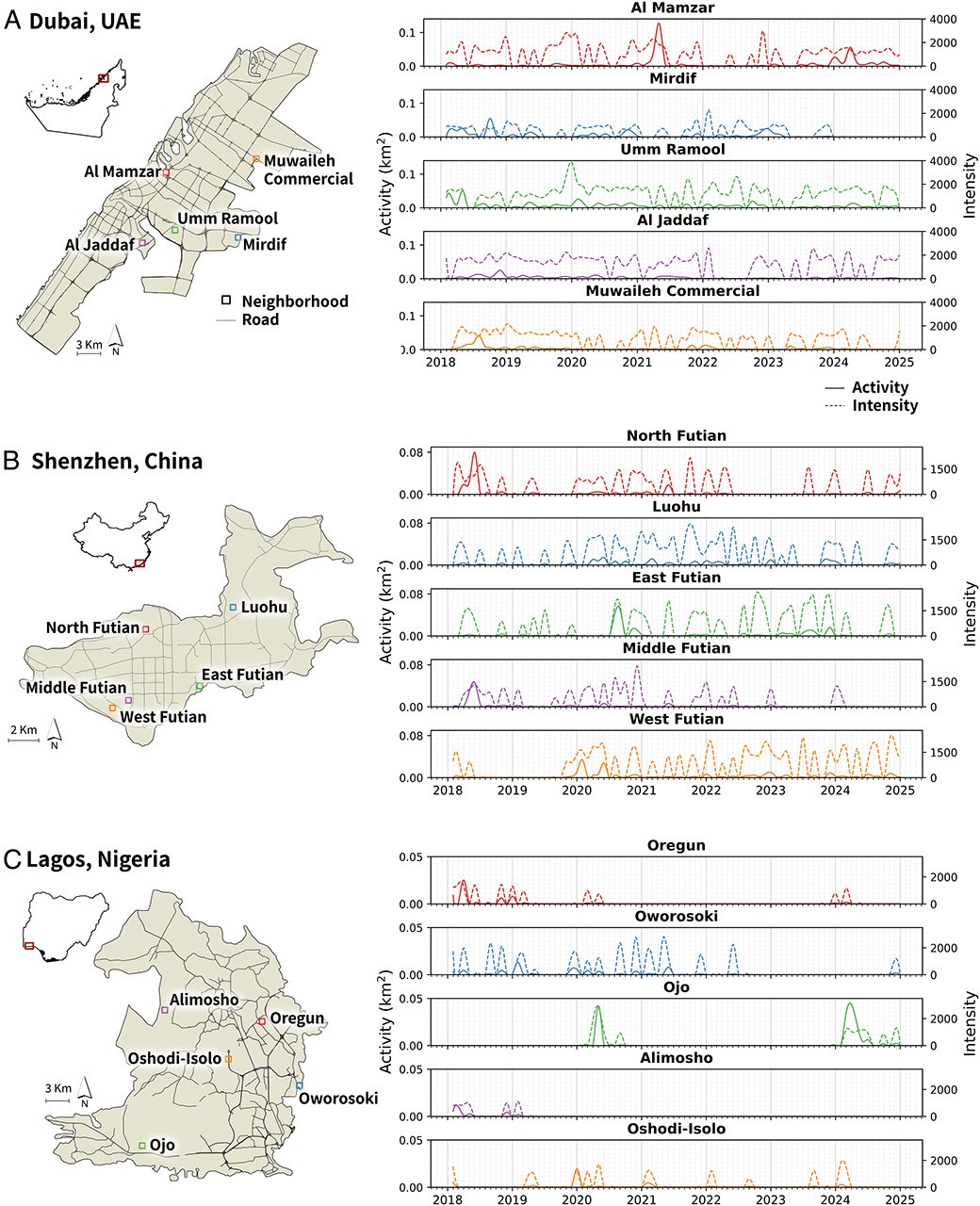
In each of the cities studied, the researchers selected five nearby neighborhoods and compared their change pulses. Across the six cities, they found that construction changes in each neighborhood are cyclical, with asynchronous spikes of change. That is, urbanization is episodic rather than continuous; cities cycle through expansion, stabilization, and decline; and different parts of the city change independently from one another.
Looking at the Al Mamzar neighborhood’s time series in the graph below, we can follow its urban pulse: periods of concentrated change appear as spikes, while quieter intervals separate these changes into cycles. Comparing Al Mamzar’s timeline with nearby neighborhoods shows whether development happened in step or at different times. The data shows that nearby neighborhoods’ cycles of change were not in sync with that of Al Mamzar, illustrating the study’s overall findings in all six cities that urban change is episodic and often unsynchronized across neighborhoods within the same city.
The Urban Pulse (UP) process takes advantage of HLS’s high temporal revisit, with new observations of the same area taken every 2-3 days, to track neighborhood changes over time rather than compare occasional snapshots. The UP framework uses deep-learning and time-series methods to infer the timing and intensity of physical changes including construction, infrastructure improvements, repairs, and demolition, turning them into neighborhood-level “pulses.” That makes it possible to study the rhythm of change: sharp bursts of activity, cycles between expansion and quiet, and what happens at different times across neighborhoods of the same city.
Other approaches that are used to study urbanization often rely on infrequent and aggregated measures, emphasizing outcomes such as built-up area or population change, whereas the goal of the UP process is to reveal when change is happening (activity) and how its magnitude (intensity) varies locally, including “shocks to the system” such as COVID-19, which is illustrated across all cities studied as a cyclical change around COVID lockdown.
Just as a human pulse can reveal changes in the body, the Urban Pulse could be used to diagnose changes in a city. By tracking construction and other physical changes at the neighborhood level, it could help planners detect early signs of infrastructure strain, economic stagnation, or environmental vulnerability and see where rapid development may be outpacing services or spreading into green space. Because a citywide average can hide sharp differences from one neighborhood to another, the pulse could help officials identify where to investigate and target responses. Local context and ground-level evidence would help interpret what the pulse is signaling.
For example, unusually intense construction bursts could alert planners to examine pressure on roads, transit, water systems, schools, and emergency services, then schedule upgrades where demand is confirmed. The framework could also support retrospective diagnosis: in the pandemic-era time series, the researchers found a synchronized dip in construction activity around COVID-19, followed by differing recovery patterns across cities. That suggests a single “city recovery” story may miss substantial local differences. The Urban Pulse framework gives planners and policymakers a clearer pulse on neighborhood change — and a sharper sense of where to act next.
Related Links
- The Harmonized Landsat and Sentinel-2 (HLS) project
- Suh, J.W., Zhu, Z., & Zhao, Y., 2024. Monitoring construction changes using dense satellite time series and deep learning. RSE, doi: 10.1016/j.rse.2024.114207
- Zhu, Z., Fragkias, M., Suh, J.W., McCoshan, E., Chen, L., Song, K., Kong, J., Li, T., & Seto, K.C., 2026. The Urban Pulse: Diagnosing the urbanization process as spiky, cyclical, and asynchronous. PNAS, doi: 10.1073/pnas.2537750123
Keep Exploring


 English (UK)
 English (United States)