From declines in annual sea ice extent to the greening of the tundra, environmental change has been unfolding incrementally in the Arctic over decades. Some shifts, however, have come on more abruptly.
Satellite, aerial, and ground-based surveys spanning more than 600 miles (1,000 kilometers) across Alaska’s Brooks Range have observed stream water changing from clear to orange in more than 200 watersheds. What’s more, scientists are finding that the switch has largely taken place within the past 10 to 12 years, coinciding with a pronounced increase in air and ground temperatures.
Thawing permafrost soils, accelerated by warming air and ground temperatures, are the most likely cause of the “rusty” rivers, scientists say. They surmise that water is now encountering thawed ground and bedrock where it previously had not. Chemical weathering of minerals leaches iron, sulfuric acid, and trace metals into streams, akin to the process behind acid mine drainage, which similarly pollutes and discolors water near abandoned mines. Microbes may also contribute to the color change by producing a soluble form of iron as they digest plant and animal matter in thawing soils, which then becomes oxygenated, or “rusts,” in flowing streams.
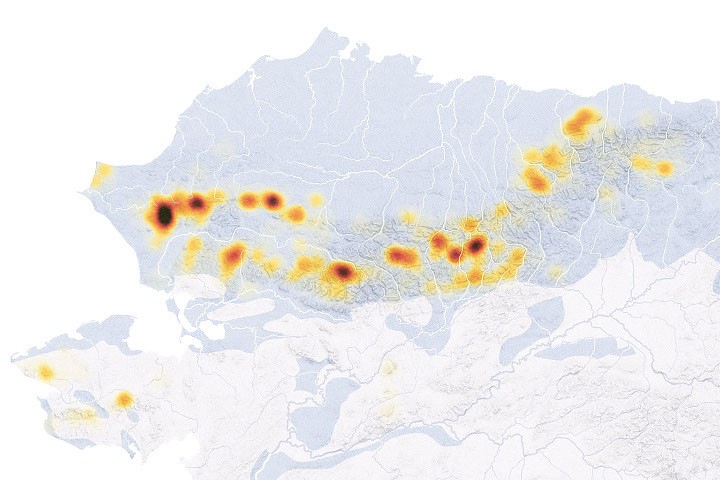
Researchers have only recently begun to comprehend the prevalence of rusting rivers in Arctic regions. In 2024, a team of National Park Service, U.S. Geological Survey, and university scientists documented 75 northern Alaskan streams that recently changed from clear to orange. With subsequent exploration, mostly using high-resolution satellite imagery, they added 200 more observations. The locations of these discolored streams, published in NOAA’s 2025 Arctic Report Card, are shown in the map above.
“I’m still surprised by the broad spatial scope of our observations,” said Brett Poulin, environmental toxicologist at the University of California, Davis. He and his collaborators have been monitoring the region’s streams since 2013—when many were still clear. “Now we’re seeing hundreds of streams that have changed color seemingly overnight, including in designated National Wild & Scenic River corridors,” he said.
Observations from NASA/USGS Landsat satellites allowed the team to determine the timing of several of these changes. For the 2024 study led by ecologist Jon O’Donnell of the National Park Service, the team calculated a redness index based on red and blue spectral information sensitive to the color of iron hydroxides (i.e., rust) in water. After analyzing a subset of streams, they found that some turned rusty around 2018 and stayed that way, while others had periods of rusting and then returned to being clear.
One stream that underwent a sudden change is the Agashashok River in Noatak National Preserve (above). In 2019, a jump in redness values appeared in Landsat data along this waterway. Ground and aerial surveys the same year found an orange section of the river several kilometers long, and vegetation around nearby groundwater seeps and springs appeared blackened. “The Landsat archive has proved uniquely useful for investigating the historical onset of rusting rivers where creeks and rivers are sufficiently large,” Poulin said.
Having gained a better picture of the extent and timing of the phenomenon, the researchers want to focus on the conditions driving the orange color’s onset and the yearly and seasonal changes. A deep snowpack may play a role some years, for example, by insulating the soil from cold winter temperatures and enabling permafrost thaw earlier in the summer. In addition, periods of higher streamflow throughout the year can dilute the discoloration. The team is planning a geophysical survey along a hillslope where acidic groundwater is discharging to the surface to investigate the subsurface geology, hydrology, and permafrost.
Further, they seek to quantify the effects on water quality and aquatic ecosystems. Communities rely on these river systems for drinking water and subsistence fisheries, and a decrease in stream biodiversity has already been documented in some locations coincident with water turning orange. The researchers now are looking deeper into the patterns of toxicity over time and space, such as where rusting rivers overlap with known spawning areas for migratory fish.
“The rusting river phenomenon is a good example of an unforeseen consequence of permafrost thaw in the Arctic,” Poulin said. “Further, it’s consistent with the emergence of acid rock drainage following cryosphere loss across Earth.”
NASA Earth Observatory images by Michala Garrison, using stream location data from O’Donnell, J.A., et al., and Landsat data from the U.S. Geological Survey. Story by Lindsey Doermann.
- NASA Earth Observatory (2024, January 16) Rusting Rivers. Accessed July 9, 2026.
- O’Donnell, J. A., et al. (2025) Rusting Rivers: Assessing the Causes and Consequences in Alaska and Across the Arctic. Arctic Report Card 2025.
- O’Donnell, J. A., et al. (2024) Metal mobilization from thawing permafrost to aquatic ecosystems is driving rusting of Arctic streams. Communications Earth & Environment, 5, 268.
- U.S. Geological Survey (2026, February 27) The Rusting of Arctic Rivers: Freshwater Ecosystems Respond to Rapidly Uptaking Metals. Accessed July 9, 2026.


 English (UK)
  English (United States)