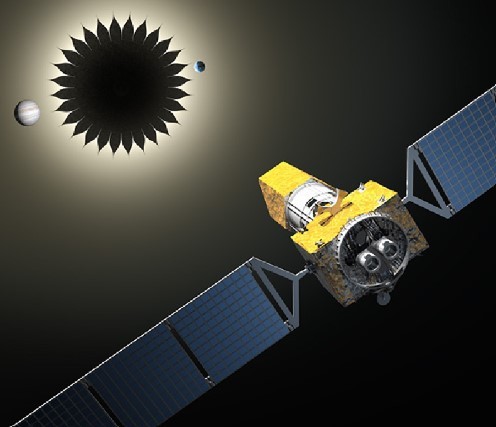
A recently developed ultra-black coating not only efficiently absorbs light, but is also extremely thin and durable, enabling its potential use on starshades that could someday support the imaging of exoplanets and potentially facilitate the detection of life beyond our solar system.
The light emitted by a star can be billions of times brighter than the light reflected from its surrounding planets. This bright starlight makes it very difficult for a space telescope to image an exoplanet — it’s like trying to find the light reflected from a gnat that is flying near a spotlight. In addition, the light from our Sun scatters off spacecraft surfaces and back into the telescope, contributing even more light “pollution” that can easily obscure the dim light reflected from an exoplanet.
A starshade is a giant, flower-shaped spacecraft (roughly half the size of a football field) that is designed to be positioned between a space telescope and a distant star so that it casts a shadow from the distant star onto the telescope. A starshade can block unwanted light from the parent star to the extent that less than one part per billion of the starlight is observable, while allowing the much fainter light from an orbiting exoplanet to pass around the starshade and reach the telescope, thereby enabling its detection. But to enable a telescope to distinguish an exoplanet, a starshade must create an extremely pristine shadow on the telescope. Not only must it block the starlight from the parent star, it must also suppress the stray light from our Sun that scatters from the starshade’s “petal” edges into the telescope.
Over the past decade, NASA-sponsored engineers have explored various methods to address the issue of stray sunlight. For example, they developed a way to make a starshade’s edges razor sharp by crafting blades from amorphous metals. The edges of these blades were only 300 nanometers thick, but data showed that even such thin metal edges would still scatter too much sunlight into the telescope.
Researchers also tried applying black coatings to the starshade edges to reduce the reflected light. Unfortunately, the existing black coatings were far too thick; they made the starshade edges thicker (duller), which actually increased the scatter. Carbon nanotube coatings, for instance, are several microns thick — much thicker than the 300-nm starshade edge. Other existing coatings that rely on three-dimensional microstructures to trap light were also too thick.
In 2004, David Sheikh, founder of the small business ZeCoat Corporation, was researching the concept of a “black mirror” — a mirror that absorbs nearly all incident light instead of reflecting it. He came across a methodology used decades ago to make light-absorbing, smooth surfaces.
Sheikh used modern computing techniques and more accurate material property data to improve this methodology, and developed a breakthrough method for manufacturing an ultra-black coating using a unique, motion-controlled, physical vapor deposition process also developed at ZeCoat. The coating design uses extremely thin, partially transparent metal layers that are separated by dielectric glass layers to form multiple light-absorbing, nanoscale cavities. When the thicknesses of the layers are tuned precisely with the aid of a computer, incoming light resonates as a standing wave inside the cavities, where the metals absorb it. The principle is similar to the Fabry–Perot cavity used in lasers — except instead of amplifying light, the light is trapped and absorbed. This new coating turned out to be 100 times thinner than those previously tested for use on starshades.
In 2020, NASA’s Exoplanet Exploration Program at the agency’s Jet Propulsion Laboratory (JPL) in Southern California chartered a Starshade Science and Industry Partnership (SIP) to maximize the technology readiness level of starshades to enable potential future exoplanet science missions. As part of this initiative, the new coating developed by Zecoat was applied to prototype starshade edges, and engineers at JPL used a custom-built laser scatterometer to measure scatter from coated and uncoated 50-cm long amorphous metal blades. These tests demonstrated that the new coating reduced the reflected light by a factor of about 20 — enough to enable a telescope to image an exoplanet. (The results of this effort were published here in the SPIE digital Library).
Building on the success of the edge coating demonstration and supported by a 2021 NASA Small Business Innovative Research (SBIR) contract, ZeCoat developed a novel thin film deposition process to coat large sheets of polyimide film with a similar ultra-black finish. The process uses multiple electron beam evaporators to apply thin, uniform films to a moving membrane substrate in a roll-to-roll coating process. These large coated membranes (~ 1-meter wide and many meters long) could be patched together to form a starshade’s central disk section, as well as its petal surfaces, which would remove even more stray light and further improve the quality of images a space telescope could produce. (For additional details, see the entry for this project on NASA TechPort and this article in the SPIE digital Library.)
Besides use on starshades, durable black coatings have a wide variety of science, military, and commercial applications. For example, they could be used to darken constellations of satellites so they are less visible from the ground, or to darken surfaces near the camera on a cell phone.
In addition, ZeCoat recently was awarded a NASA SBIR Phase I contract and is applying the thin-film roll-to-roll coating process described above to develop thermal control coatings that are resilient enough to mitigate damage from micrometeorite strikes. These coatings could be potentially used on future space vehicles such as the Habitable Worlds Observatory.
For additional details, see the entry for this project on NASA TechPort.
Project Lead: David A. Sheikh, ZeCoat Corporation
Sponsoring Organization(s): NASA Astrophysics Exoplanet Exploration Program, NASA STMD, NASA JPL
Some of the work described above was carried out at the Jet Propulsion Laboratory, which is managed by Caltech for NASA (80NM0018D0004).


 English (UK)
  English (United States)